
Retro: Cause-and-Effect Diagram
Provides amazing insights and sometimes doubles as art

Provides amazing insights and sometimes doubles as art
The Cause-and-Effect Diagram is one of my favorite Retrospective activities. It is of course available on Retromat.
Retromat: Cause-Effect-Diagram (#25)
Find the source of problems whose origins are hard to pinpoint and lead to endless discussionretromat.org
The core idea is quite similar to 5 Why’s excepted that not only focuses on root causes but also investigates on the consequences (effects). Plus it is neatly visualized using a diagram.
When it is properly facilitated, participants usually love this activity because it is analytical and it helps surfacing true issues.
However, I found it was not the easiest activity to facilitate. I’ll share some of my tips in the end of this post.
Two kinds of diagrams
From my experience there are two big kinds of Cause-and-Effect Diagrams:
Clear effects and causes
Effects provide a feedback loop to the causes
Case 1 usually happens in healthy teams/organizations while case 2 is often the case of a dysfunctional team or organization.
Example: clear effects and causes
This is an example where the topic is subject to causes and leads to effects:
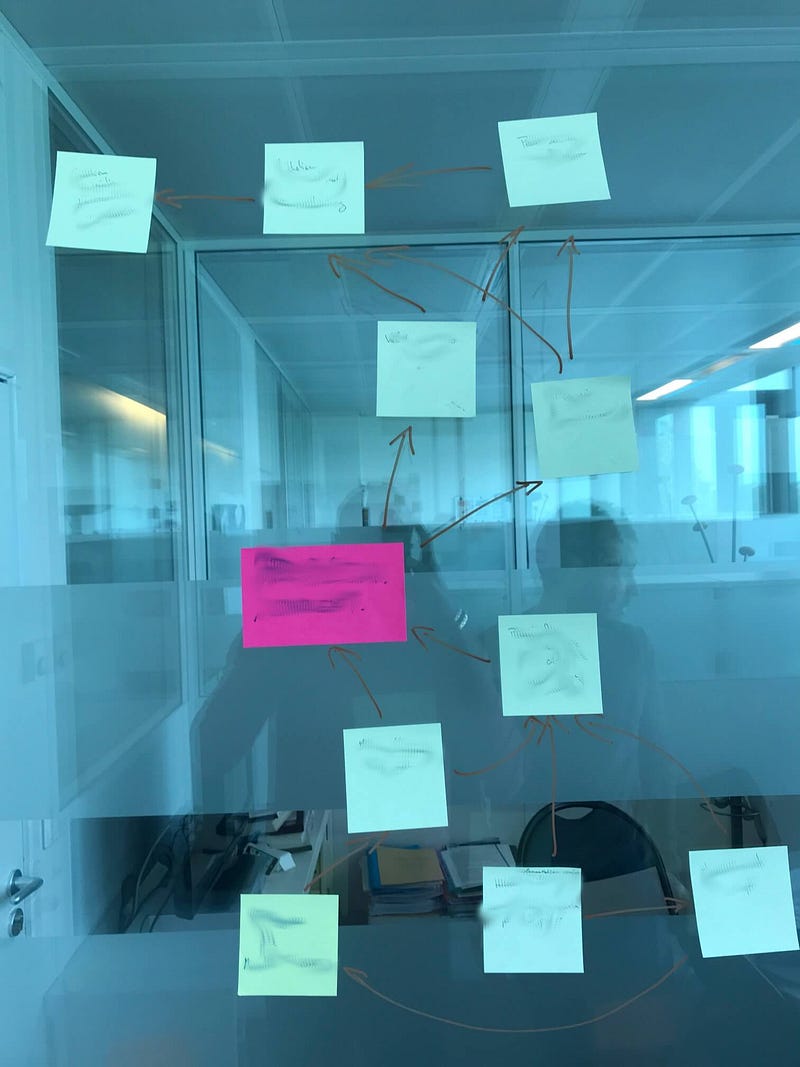
There is no feedback loop. This kind of diagram is quite common. It happens for instance when we are talking about processes.
Basically the team is working and we seek to improve the process. We understand why something happens and the degree of seriousness. Using the diagram we can assess which impacts the new process will have on the system. Works great 👍
When feedback loops kick in… #PsychologicalSafety
On the other hand, here is another diagram where effects and causes intertwine to be one:
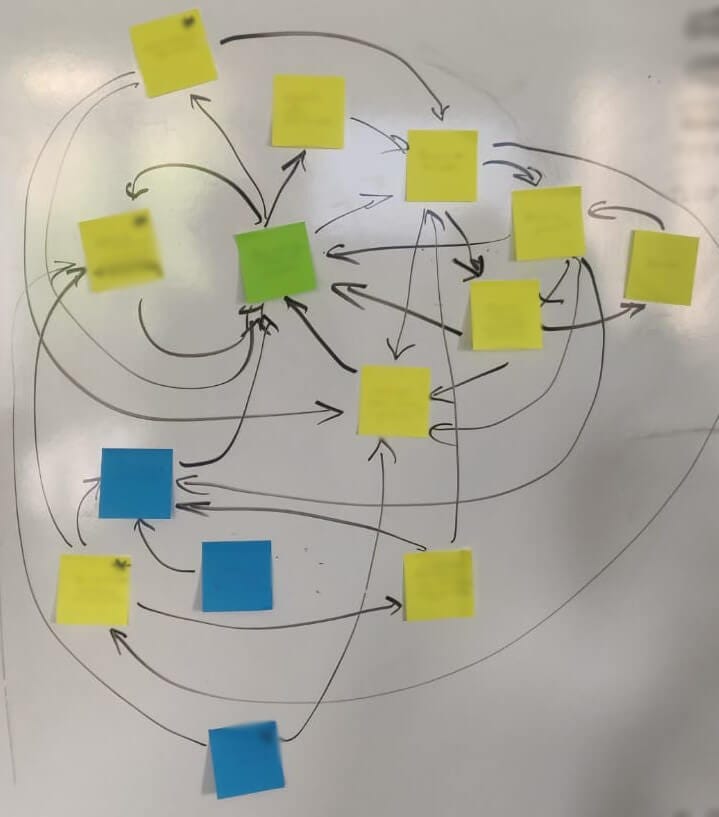
(no fake, this is an actual diagram made during a real Retrospective with a real Scrum team)
There are feedback loops everywhere. This kind of diagram is less common. It happens for instance when we are talking about a set of topics which are hard to isolate from each other, typically:
Trust
Psychological safety
Relationships
Management
Stress
Lack of sense of initiative
Motivation
Involvement in company
Level of empowerment
Right to fail
Culture
And so on…
In this kind of environment we see that most issues actually reinforces themselves, directly or indirectly. For instance:
Hard to deliver → unable to build trust → lack of trust → stress → hard to deliver
Micro-management → lack of trust → micro-management
It makes sense. All these topics have strong consequences on behaviors, meaning they influence other people and how these other people influence the system back.
In this case of feedback loops, the goal of the Cause-and-Effect Diagram is to find out how to break the feedback loops. This might be an even more powerful activity when that happens.
Is it the ultimate diagnostic?
Seeing a Cause-and-Effect Diagram full of feedback loops can be scary, yet it is a perfect reflection of what’s really going on in the company.
When you perform a root-cause analysis and you discover such feedback loops, you know that you’ve found a true problem to tackle, one of the core underlying issue undermining the company. You know you’ve found something that will inhibit the team and prevent it from growing any further.
We could say that this is the ultimate diagnostic for a company. If when you research a common issue all you find is simple effects and causes then the company is probably not that in a bad shape.
On the other hand if you find feedback loops then you should start worrying — there is still a long road ahead.
Facilitation tips
The Cause-and-Effect Diagram activity can consume a lot of time. As a facilitator you have to keep your eyes on your watch.
Matching other activities
This activity might not be a good match for all retrospective formats.
About time: This activity can take a lot of time so it might be a bad idea to mix this activity with other time-consuming activities.
About inputs: This activity’s starting point is one fact. Not all Gather Data activities gather facts. In addition, this activity requires only one fact to build the diagram upon. So if you end up with several facts worth investigating then you’ll have to find a way to select only one. On this topic, please have a look below where I explain how focusing on effects first helps.
About outputs: This activity ends up with root causes. This means that the following Decide What to Do activity might have to define the actions to take and not only to refine and select them. This is also a reason why this activity takes time — when the analysis is done, you have more work to do to figure out potential actions.
Divergence vs. convergence
This activity will naturally follow several phases. You have to be aware of which phase the group is in so that you can make sure you keep enough time for the rest of the activity:
Divergence: people brainstorm to write new ideas, or to build on already written ideas
Convergence: people analyze and discuss ideas to find the most important ones and truly understand the root causes
You typically don’t want the team to spend more than half, or maybe even quarter of the time on the divergence part. You want people to discuss and tackle issues so you really want a proper convergence part.
Of course, new insights during the convergence part can lead to a new, small divergence part. That’s OK as long as it is relevant to the topic but make sure it is quick so that there is enough time left to finish the activity.
Finally, keep in mind that the result of the convergence phase might or might not be potential actions. You need to keep some time for this part too, if it is not included in the rest of the retrospective.
Start with effects
People tend to focus on causes because their usual focus is to solve problems.
I recommend to start with effects. My main reason is that before spending a lot of time on understanding the causes, I want to make sure that this will be time well spent: are the effects worth the effort?
This is a neat way to make sure that we are investigating the good topic. If by looking at the effects we end up finding that the topic is not that a big deal, then maybe we can switch to another topic before it’s too late. That should have wasted like only 5 minutes so unless you are with a very small timebox you can still do the activity with another topic.
Too many people
If you do this activity with many people you may find that the activity takes too much time, or that some people are inactive.
This is common with such free-form activities. Depending on your team, you could try to split the team in several groups, each doing its own diagram and analysis. Or you could also try to perform the divergence part all together, and then to do sub-groups to analyze different parts of the diagram.
As a last resort, you could also focus the discussion through a classic Park Bench, where there is only a few sit places and only sit people can talk.
Retromat: Park Bench (#41)
Group discussion with varying subsets of participantsretromat.org
About psychological safety
Not what you think it is: Roles and Responsibilities Workshop
Use it to surface people issues in the team!jp-lambert.me
Retrospective: Building Psychological Safety
Sharing tools that we should all know and be prepared to usejp-lambert.me
All my ressources about the Retrospective
Mes articles sur le thème de la Rétrospective
Voici la liste de mes articles sur le thème de la Rétrospective.jp-lambert.me
This article is in French but some references are English articles, or with an English version available.
Liked this article? Show it!
Please clap 👏 and share the article! It is because of you that I put my heart and soul into writing.
And follow me on my blog to be notified when I publish new articles!
Thank you so much!