
Physical vs. electronic: choose wisely!
Doing my best not to be biased 😏


Doing my best not to be biased 😏
Following up my last Scrum Life video debating o n the pros and cons of physical vs. electronic boards, this post recaps the takeaways in textual form.
Which is best? Physical or electronic?
First, let’s split the question in two parts: workshops vs. project management. Project management both includes iteration-level and longer-term planning.
For each question, let’s also consider the possible answers: physical, electronic, or hybrid mixing both physical and electronic.
Finally, the most important element of decision is whether the team is remote. Another common element of decision is scale: is it just a single team or hundreds of teams?
TL;DR
Here is a simple chart summing up my default recommendation:
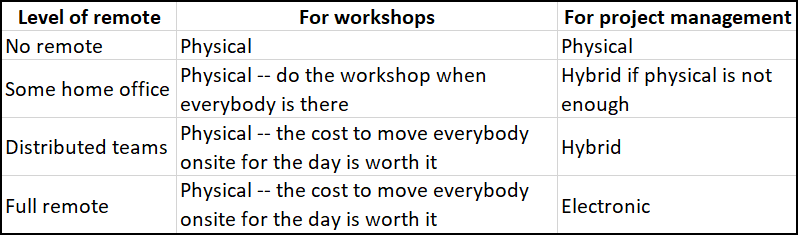
The basic rule would be:
Favor physical as much as possible, and move to hybrid and then to electronic once physical has been proven inadequate in your context.
Note that I did not mention the scale in this summary. That’s because, again, you should try physical before falling back to electronic.
Do not default to electronic just because of scale but because you tried it and it did not work.
Workshops
As you may have noticed in the TL;DR previous section, physical is basically the only way to go for workshops.
“Agile” meetings must use post-its, otherwise they are not “Agile”!
(Sorry for trolling 😝)
Jokes aside, physical is the way to go for so many great reasons:
More and better interactions between participants
Everything can be seen at the same time
People can move stuff as they want, they can split in subgroups or merge together in a bigger group
Holding stuff in his hands use more parts ofour brain and thus makes it easier to remember later what was said
What about remote?
Obviously, physical will be hard if people are not colocated.
You may feel like there’s no way around using an electronic tool, but I’d rather suggest moving everybody in the same place so that they can attend the workshop.
Moving people may sound very costly, but thinking so would be neglecting how much costly it is to keep people remote:
People not fully understanding each other, while workshops are meant to bring common understanding (which is already very hard with people in the same room)
People being shy or even dishonest, because they don’t know each other and maybe because they are not fluent in each other’s language; having people physically meet is the best way to solve or work around this
Maybe you don’t need to move people together on a regular basis, but you should definitely consider getting them together for key workshops.
Getting them together will literally ease the whole project. So is it really that costly? I don’t think so.
Project management
Project management is usually the reason why some massive tools like JIRA are bought and forced down the throats of so many teams.
While this makes sense when scaling to a lot of teams to ease coordination in such a case, I would recommend always trying physical before moving to such a tool.
Indeed, most magical reports that such tools bring are rather trivial to do by hand or with a simple spreadsheet.
As for the trickiest tracking provided by these tools, like a fine tracking of tickets transitions, teams are usually very fond of it but rarely (if ever) use it to actually drive continuous improvement.
Visual management
Going physical opens to the awesome work of visual management.
If you’re new to visual management, I can only recommend Jimmy Janlén’s book. It is a fantastic collection of visual management examples. I suggest you have a look at my post about this book to give you a sneak peek:
Lecture : “96 Visualization Examples” par Jimmy Janlén
Un petit livret plein de fantastiques conseils sur le management visuel d’une équipe Scrum ou Kanban !jp-lambert.me
You can also find other examples in various posts I wrote. For instance:
All these examples can hardly be implemented with an electronic tool, which brings a lot of constraints while going physical unleashes creativity and flexibility.
What about remote?
Now remote is a real deal-breaker to do project management with physical artefacts only.
(Well, Jimmy Janlén does not hesitate to suggest using a webcam to keep remote workers up-to-date…)
Depending on your company’s use of remote work, you may or may not stick to physical-only:
Full remote company obviously implies using electronic tool
Distributed teams will do wonder with an hybrid approach, having physical boards on each sites and using the electronic tool to sync them
If your company is only practicing a few days of home office per month, physical only might do the job well, but hybrid might be better option depending on the people on the team
Hybrid?
Having both physical and electronic at the same time does not necessarily mean that all the information is mirrored in both.
A nicely working approach is to actually have physical and electronic complement each other.
For instance, it is common to keep User Stories, Epics and Releases into the electronic tool while Tasks are simply kept on the physical board. This way, bureaucracy in the tool is reduced, while keeping the advantages of going physical.
Why so much hate for electronic tools?
So far, we basically only mentioned the pros of both physical and electronic.
Now about the cons…
Physical cons
Obviously, the biggest con of physical is that you need to be in the same room. That’s why in the previous sections I recommended using an electronic tool for remote teams.
Electronic cons
Now, electronic tools have a lot of cons that I didn’t mentioned yet.
The first big set of cons is about the usage:
You look at them through a monitor or TV, which makes it impossible to see everything at the same time with enough details
You also need some kind of computer user interface to use it (typically keyboard+mouse, can be touch screen if you are high-tech) which can make it tedious
Not to mention that only one people can interact with it at the same time; there is no way somebody would be adding some Task while somebody else would be talking and pointing out things
Maybe you can ease this first set of cons through high-end technologies, even I personally doubt we’re getting even close to physical in terms of visualization and flexibility.
And now another big set of cons is about the process:
Tools come with many process constraints; you’re not free to use them the way you want
The more flexible tools are, the more complex they become to configure — and things can become a real mess if you don’t pay attention
Rights: maybe you can’t do what you want if you’re not admin
That may sound like a stupid issue, but in many companies it is not natural to give admin rights to the teams. Hence it becomes incredibly hard for a team to own its own process! 😵
All too often, these process contraints are simply skipped while they should be thought deep. Once the team is knee-down into a tool, it’s really hard to get rid of it!
Start with physical!
All these cons — and especially the ones about process — are making the point that, really, a team should start as much as possible with physical. And then move to electronic only once the current context of the team proves to need it.
Liked this article? Show it!
Please clap 👏 and share the article! It is because of you that I put my heart and soul into writing.
And follow me on my blog to be notified when I publish new articles!
Thank you so much!