
Is the UX designer the future of functional tester?
How does the two roles relate to each other?


How does the two roles relate to each other?
I already mentioned in a previous post how the Scrum Life community provides me with interesting insights and thought-provoking ideas.
How to subtly fail at implementing Scrum
Thanks to the Scrum Life community for making me think!jp-lambert.me
Well, it happened again!
In the latest Scrum Life episode, I’m talking about the tester role in an Agile setting…
The video got his share of comments. Many were sharing their experience, some did not fully agree with what I say in the video… But one specific comment stood out:
(the following quote is my home-made English translation — all loss of meaning are on me!)
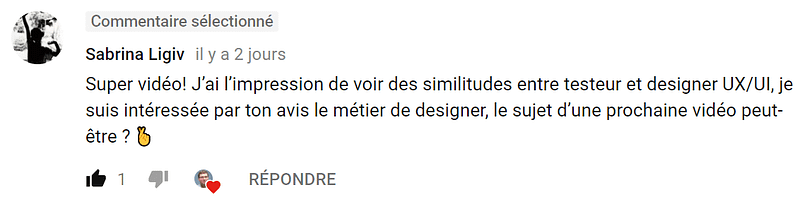
Sabrina Ligiv: Great video! I feel like I see some similarity between the tester and UX/UI designer roles, I would be interested in your opinion about the designer job, maybe the topic of a next video? 🤞
I mean — what?
What do the tester and UX/UI designer roles have in common?
Well, I believe that’s an interesting take on both tester and UX/UI designer jobs.
“Usability test”
Who’s gonna handle the usability tests on the product?
It’s at the very core of the UX way
Yet it’s a test!
On this specific task, both the tester and the UX/UI designer would do a great job. This really teases me as to what’s the difference between the two roles.
Mindset & skillset
Actually, I believe that the tester and the UX/UI designer would share the same mindset: they will both try to leverage the usability test to get information on what’s wrong with the current solution, what could be a better solution, experimenting with ideas.
Yet their skillsets are clearly different: while the tester will focus on user feedback, the UX/UI designer will focus more on interpreting what the user says, trying to get her feelings and what’s happening in her head.
The purpose of the UX/UI designer role is that the user does not know what she wants, and even sometimes does not understand why he likes or dislikes the product. It can be innate or subconscious.
What about handling user feedback? Monitoring, data analytics and bug reports?
This is another topic of interest for both testers and UX/UI designers.
It is just second nature for testers: handling bug reports and interpreting data to understand what’s going on in production.
Yet UX/UI designers are eager to tap into any feedback source on the current product.
Mindset & skillset
Again, both tester and UX/UI designers share the same mindset: they try to gather as much data as possible to improve the product.
And again, too, their skillsets are very different. The tester will focus on qualifying and sorting these feedbacks, while the UX/UI designer will more focus on drawing patterns out of these feedbacks in order to grow new initiatives on the product.
The tester is the master of risk-analysis and will be able to qualify and prioritize bugs like no other. They have an innate skill to transform raw data into understandable, actionnable feedback.
Close ties, complementary roles
In the end, the tester and the UX/UI designer roles are closely related. They tend to go to the same meetings and to be interested in the same data.
Yet their approaches and skillsets are different — the two roles actually complement each other nicely.
Could we draw the line this way?
Testers tend to be more analytical than UX/UI designers and they will greatly help the team — including the UX/UI designers — to get useful information out of the raw feedback of users and data analytics.
UX/UI designers tend to be more creative than testers as they will turn feedbacks into initiatives and actions for the team.
Can we try to challenge this analysis?
Doing exploratory testing requires creativity. Or is it? It’s also a lot about applying heuristics and other techniques.
Data analysis is at the core of the UX philosophy. But how do you come up with truly innovative ideas without creativity?
So we see that the line between tester and UX/UI designer can be thin…
Is it logical to move from tester to UX/UI designer?
I’d like to start with some background about the tester job. In the testing community there has always been this kind of split between functional and technical testers.
I’m not saying it out loud in my video, but it can be seen that the difference between functional and technical testers is slowly but surely going away:
Test automation: Of course I had to mention it. Nowadays we expect from any tester to be able to automate some kind of stuff. And indeed it is less and less a developer’s job: tools are directly available that enables non-technical people to automate tests, for example through record-and-replay approach.
White-box testing: As I mentioned in the video, the Agile tester will work ever closer to the developer. At some point, what does the tester is white-box testing: testing while knowing the content of the piece of software that is tested. This is a good thing but that inevitably moves the tester closer to the tech — which is great, of course.
Acceptance criteria definition: Testers are expected more than ever to take an active part in the definition of the product, with a specific focus on defining the acceptance criteria. Having a true functional vision helps definitely.
When we think about it… The job on the decline is neither the technical tester or the functional tester… It is the dumb tester. You know, the one where you only pass over and over the same test cases, adding no value to the product.
Yes, this kind of job is on the decline. And I sincerely hope that no one complains; this is a mindless job.
So what’s your future as a tester?
The logical path for the tester would be to truly grow both his tech and functional abilities to become an awesome Agile tester, blending both areas.
Yet if that’s not what you want, what are your other options?
If really you’re into tech you might want to become a software developer. I’m pretty sure that you code already. Your tester background will actually be of great help as a developer. Or maybe focus you skills on test automation if that’s what you love — it’s up to you!
If you really want to avoid tech then you might want to have a look at other, less-tech roles, like business analyst, Product Owner, or… UX/UI designer! Of course it all depends on your tastes and abilities.
So yes! Moving from tester to UX/UI designer might make sense.
Liked this article? Show it!
Please clap 👏 and share the article! It is because of you that I put my heart and soul into writing.
And follow me on my blog to be notified when I publish new articles!
Thank you so much!