
Diagnose relationships between team members
Through the Retrospective


Through the Retrospective
Cet article est également disponible en français.
Let me introduce a Retrospective activity that will enable:
To put tension between team members on the table
And to detect perception gaps inside the team
But also to pat each other on the back if everything is fine 😉
Following the Retrospective format introduced in “Agile Retrospectives” and used for instance by Retromat then this activity is meant for the Gather Data phase.
The activity
This activity is rather simple, though a bit long.
The main idea is that the participants will compare how they perceive the relationships between each team members.
This activity is time-consuming because we’re going to check all relationships, with no exception. The number of relationships in the team growing exponentially with the number of team members. By example in the cover picture of this article the team is made of 7 members which translates into 21 relationships.
Everybody thinks about it in private
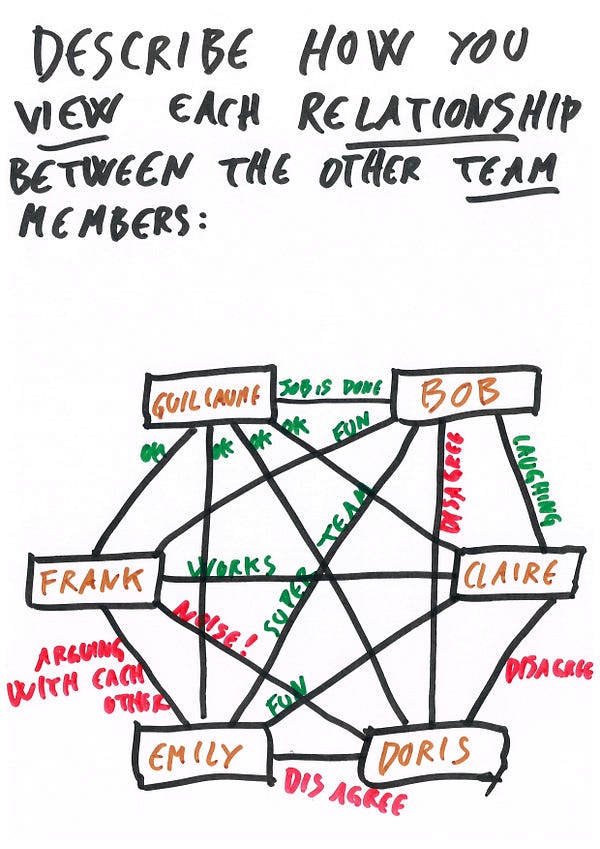
The activity starts by working in private. Each participant will fill in two sheets.
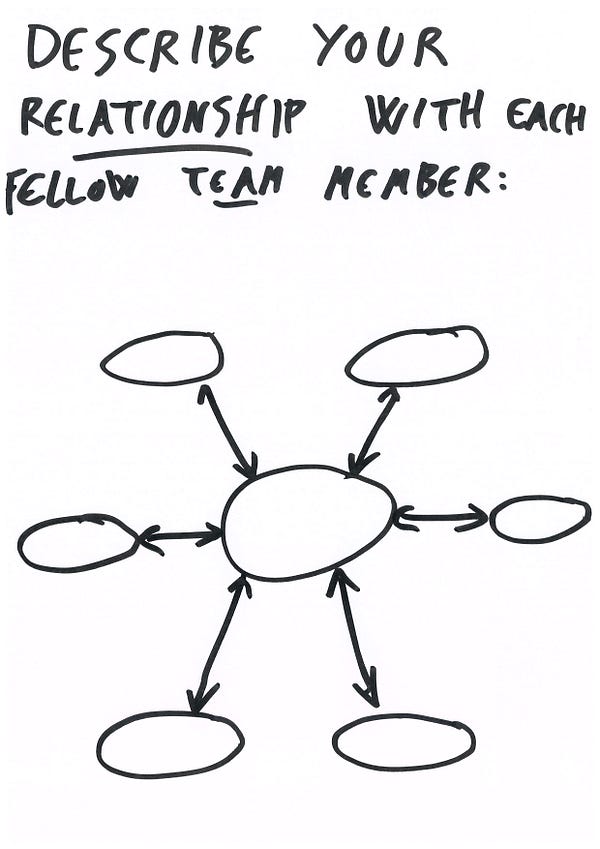

The participant marks his name in the center of the first sheet, and must describe each of the relationships between her and the other team members.
The participant is missing from the latter sheet, and this time must describe how he sees the relationships between each of the other team members.


When possible, please try to get the blank pages ready before the Retrospective to avoid wasting time.
Why using two sheets?
First to make room on these sheets, since they will clutter up pretty quickly 😛
And then because these two sheets fits how this data will be debriefed in the next part of the activity — in two phases!

Sharing and summing results
Once everybody is done, we move on to sharing. The idea is to aggregate everybody’s results but above all to detect perception gaps.
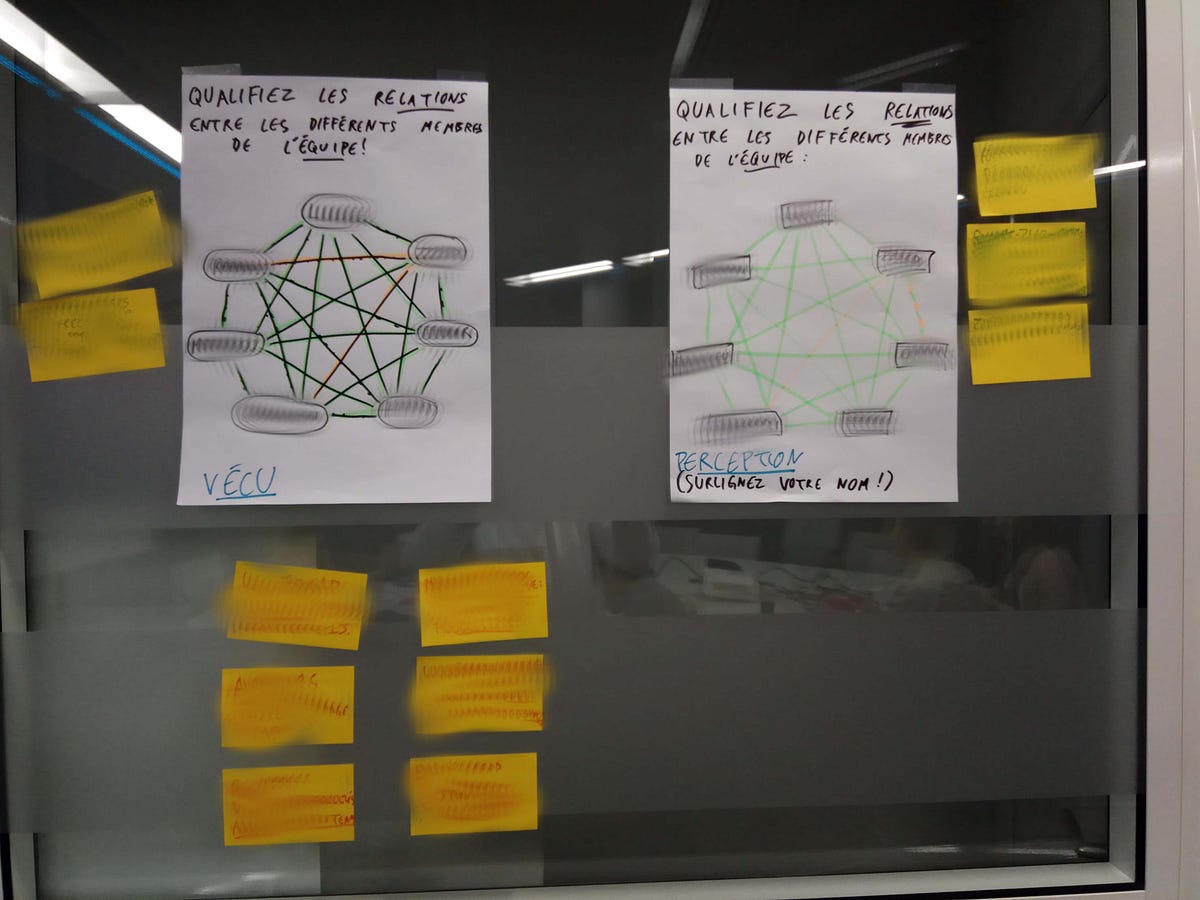
The facilitator will take one by one each of the relationships in the team, and will make a graph of the relationships between all team members. To this end she fills two different sheets:
On the first sheet she will mark if the relationships are doing OK or not, as stated by the participants of this relationship
While on the latter sheet she will mark whether there is a perception gap between the participants of this relationship and the other team members
In order to get this information, the facilitator will ask these two questions:
Talking to the two participants of the relationship: how do you describe your relationship?
Talking to the other participants: how do you see this relationship?

The two participants of the relationships are the only one allowed to answer to the first question, providing their view one at a time. The facilitator takes note of any difference, but also and above all of any tension element. She adds some color (using for instance green and orange highlighter pens) on the relationship link on the first sheet depending on the outcome of the discussion: is the relationship going smoothly?
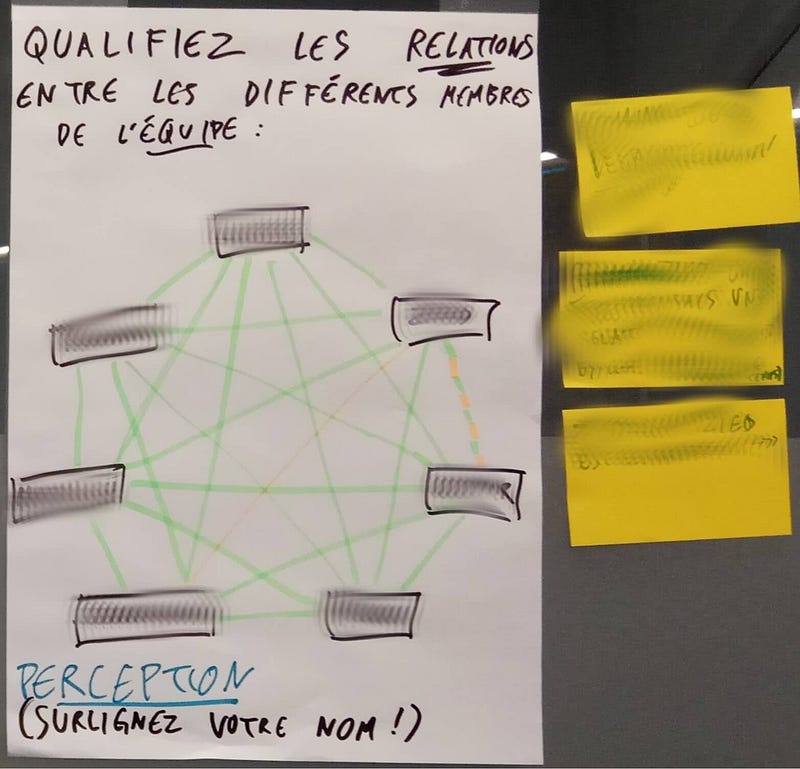
All the other participants then answer to the latter question, this time not to know if how the relationship is going but to know if everyone sees the relationship the same way that they live it. If the relationship is troubled, is it obvious to everyone? Or is the team seeing problems in some relationships while actually it is going fine? The facilitator takes notes about the perception gaps with respect to the reality. She adds color on the relationship link on the latter sheet depending on the outcome of the discussion: is everyone seeing the same thing?
Debrief
Once all the relationships have been reviewed, it’s time to have a second look at the links of concern:
Why is this relationship having a hard time?
Why this wrong view of this relationship?
There is probably patterns to be uncovered. Let’s say that a team member is wrongly viewed as the team’s teach lead (wrongly because it has never been said or agreed): this would explain easily why the rest of the team injects more stress into this team member.
Rolling with the next activity
As usual, the Retrospective keeps rolling with other activities that will dig further these elements and to define improvement actions.
Closing
This is a lengthy activity but it can be a worthy investment of your time!
As far as I am concerned, this activity enabled the team to disarm a growing tension in the team, avoiding any critical situation. Even better, since the problem has been fixed by an open discussion then the activity has helped bonding the team together. They understand better each other now.
And let’s not forget all the nice things they told to each other during the activity! 😄
Liked this article? Show it!
Please clap 👏 and share the article! It is because of you that I put my heart and soul into writing.
And follow me on my blog to be notified when I publish new articles!
Thank you so much!